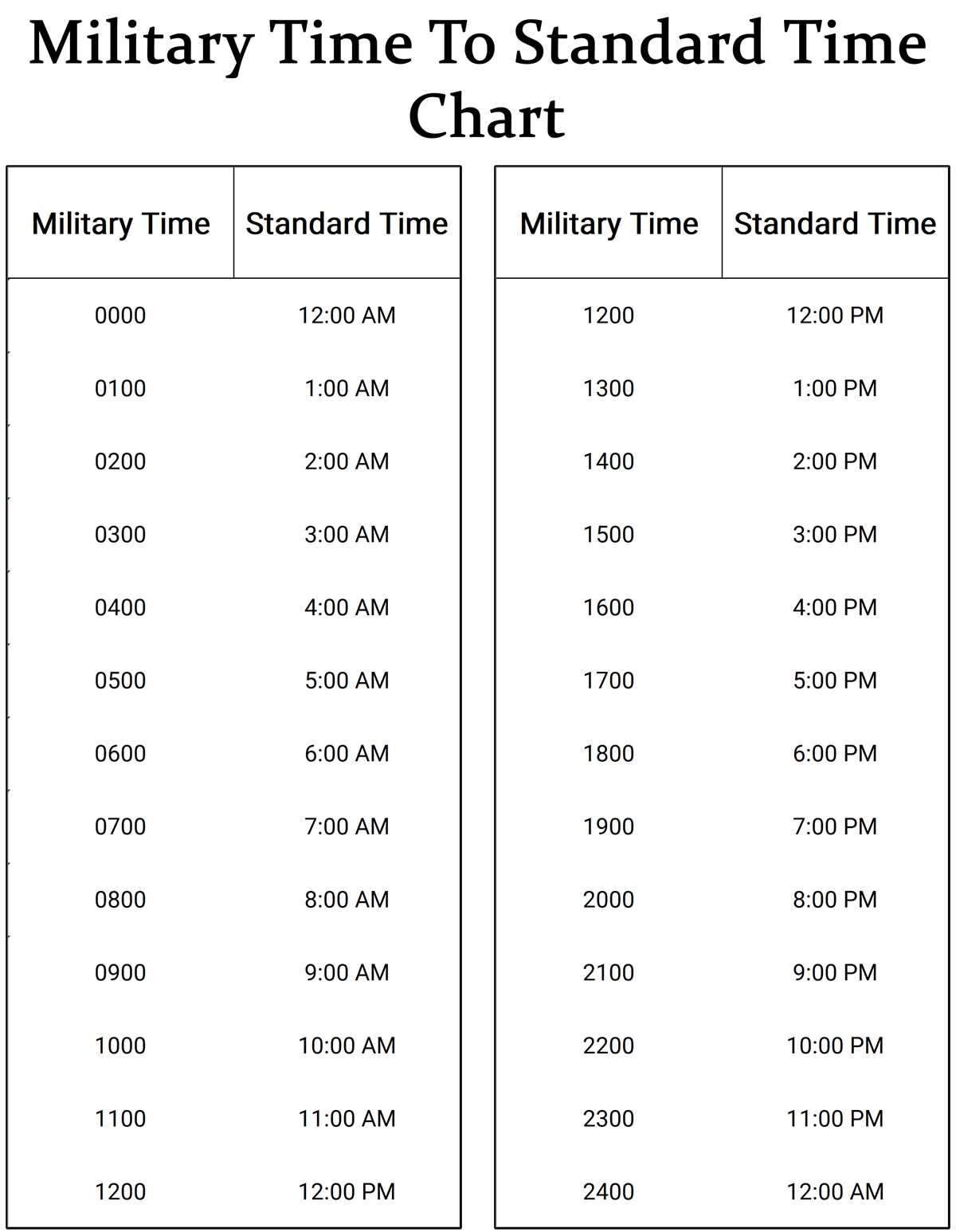
To convert standard hours into military format, a reference table can save time and prevent mistakes. This tool provides a simple, visual way to compare both systems side-by-side, making it easier to quickly switch between them without confusion.
One effective way to use this tool is by manually checking the corresponding number for each hour. For example, to convert 3:00 PM to a 24-hour system, simply locate the row for “3 PM” and note the equivalent in the 24-hour column. This method works in various environments, from military settings to international travel schedules.
If you are learning to use the 24-hour clock format, keeping a printed reference guide nearby can help you track progress. It’s useful for students, professionals, or anyone who frequently deals with schedules that rely on the 24-hour system.
Time Conversion Reference: Practical Uses and Tips
One of the most common uses for this tool is in scheduling. In workplaces where the 24-hour format is standard, keeping a reference nearby helps ensure that deadlines and meeting times are understood universally. For example, instead of asking whether 4:00 PM or 16:00 is correct, a quick glance at the guide clarifies the conversion.
Another practical use is in travel. Many airlines, train services, and international transport systems use the 24-hour system. If you’re booking a flight or checking a train schedule abroad, this guide can simplify the process by offering a fast, easy way to convert the times from a 12-hour system into 24-hour format.
Students, especially those learning military-related subjects or navigating international timetables, often find this tool invaluable. It supports learning by providing a visual aid for converting between the two systems, which helps students internalize the differences more easily.
For those in emergency services or law enforcement, using the 24-hour clock is standard. Having a printed reference ensures quick, accurate conversions in situations where time is critical. Whether it’s scheduling shifts or recording events, this guide allows for swift and mistake-free time management.
In the digital world, knowing how to convert between time formats is crucial for developers working with time data in software applications. Having an easy way to convert between formats ensures accurate logging of time stamps across different systems, reducing errors in time tracking applications.
For personal use, this reference is handy when dealing with military personnel or communicating with people in different countries who prefer the 24-hour format. It eliminates confusion and helps keep everyone on the same page regarding scheduling, whether for calls, meetings, or events.
One important tip is to get familiar with key times that often appear in schedules. For instance, 0000 or 2400 (midnight) might be confusing at first glance. With a reference guide, users can quickly convert and understand these unique time representations without hesitation.
- Keep a printed version in your work space for quick access.
- Use a digital version on your phone or computer for on-the-go conversions.
- When teaching others, use real-world examples like flight or train schedules to reinforce learning.
How to Read and Interpret Military Time on a Converter Chart
To interpret the 24-hour system, start by identifying the hours listed. The chart typically displays hours in a vertical column, with corresponding times in a 12-hour format next to them. For example, 0000 at the top corresponds to midnight, while 1200 represents noon.
When the hour is between 1300 and 2359, subtract 1200 from the number to convert it into the 12-hour system. For instance, 1500 becomes 3:00 PM, and 2300 becomes 11:00 PM. This simple subtraction helps clarify times in the evening.
For hours before 1200, the time remains the same in both formats. So, 0900 is simply 9:00 AM, and 1100 is 11:00 AM. These are the easiest conversions since the numbers match between the two formats.
The key difference to look for is that the 24-hour format eliminates the need for AM and PM. Understanding that any number larger than 1200 represents an afternoon or evening time is essential for quick conversion.
Charts will often include both 12-hour and 24-hour formats side by side, making it easier to cross-reference. If you need to convert a time to 24-hour format quickly, this visual aid allows you to find the equivalent without doing the math manually.
If you’re working with schedules or logs, pay attention to how times are recorded. In some cases, a notation like 2400 or 0000 might indicate midnight at the start or end of the day. These notations are important when timing events or planning activities that span overnight.
- Familiarize yourself with common times such as 0900, 1500, and 1800 for quick referencing.
- Always double-check the chart when using military time for scheduling or travel planning.
- Practice converting times by starting with simpler numbers like 0900 and 1200 to build confidence.