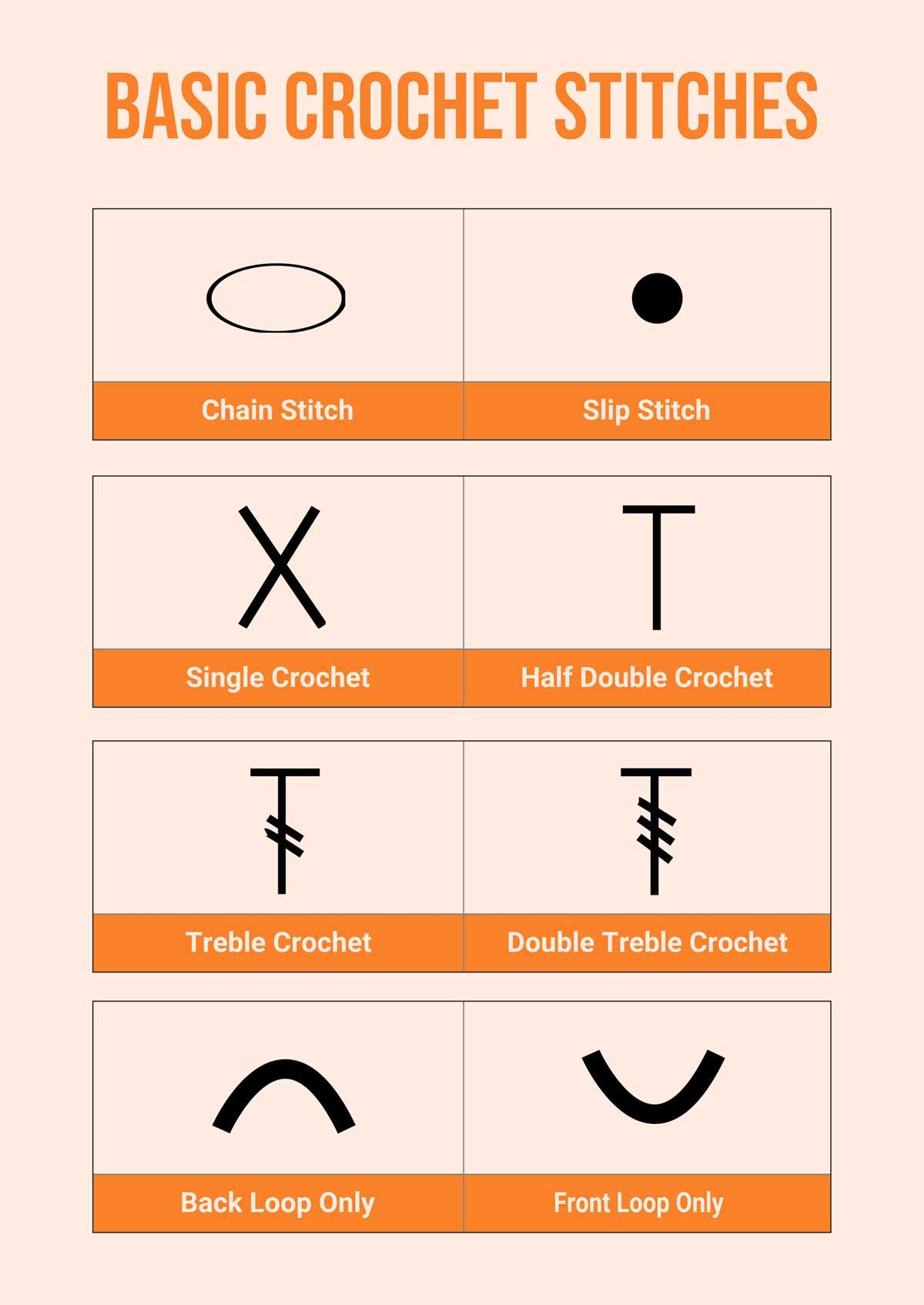
To simplify your crafting, refer to a visual guide that represents key stitch instructions. This reference is a time-saver and helps you avoid confusion when working from patterns.
Start by printing a high-quality version of the guide that you can keep handy. Choose a design that clearly distinguishes between different stitches and includes a comprehensive set of symbols, so you’re never lost when reading instructions.
Having a visual tool will make it easier to follow written patterns. For beginners, this chart is helpful to understand the different marks and shapes used to represent each stitch type. Once familiar with the most common symbols, you’ll be able to work from patterns with confidence.
If you like customizing your work, consider adding personal notes or highlighting your favorite patterns on the guide. A printed version also allows you to have a quick reference at your side without switching between screens, perfect for uninterrupted crafting sessions.
With a printed guide in hand, you’re set to tackle projects of any difficulty. Keep it next to your workspace and refer to it when needed, whether you’re learning new techniques or creating intricate designs.
Crochet Symbols Chart Printable Guide
Start by selecting a high-resolution guide that clearly displays all the key stitch representations. This will ensure that your references are easy to read and interpret, helping you follow patterns more accurately.
Once printed, keep the reference close by during your projects. Mark the most frequently used stitches or highlight areas that are often confusing. This way, you can quickly refer to the chart without losing focus on your work.
- Make sure the guide includes both simple and complex stitch representations.
- Opt for a version that uses a clear, legible font for the stitch names and descriptions.
- Consider printing multiple copies for different workstations or craft areas.
As you gain more experience, you’ll likely start to remember the meanings of the most common patterns. At that point, you can reduce reliance on the guide, but it’s always useful to have it on hand for reference when tackling unfamiliar patterns or techniques.
How to Read Crochet Symbols for Beginners
Start by familiarizing yourself with the most common marks. Each stitch has its own symbol, and these are usually represented by simple shapes or lines. For instance, a single crochet stitch is often represented by a small “x” shape, while a double crochet stitch appears as a “T” shape.
Next, understand the direction of each stitch. Most diagrams use arrows or other visual cues to indicate the direction in which the stitches are worked. This is critical, as it shows whether you need to work in rows or in the round.
As you study patterns, pay attention to additional instructions such as increases or decreases. These are typically indicated by extra marks around the basic stitch symbol. For example, a symbol with a circle around it could indicate a decrease, while a “V” shape might show an increase.
| Symbol | Meaning |
|---|---|
| ● | Single crochet stitch |
| ▲ | Double crochet stitch |
| □ | Half double crochet stitch |
| ↗ | Increase stitch |
| ↘ | Decrease stitch |
It’s also important to learn the symbols for special stitches, like shell stitches or clusters. These may involve multiple symbols in one space, with instructions indicating how many times to repeat the stitch.
Finally, practice reading a pattern alongside the diagram. By doing this, you can quickly cross-reference and become comfortable with the symbols. As you continue to work, you’ll get used to recognizing these marks more intuitively, making your crafting process smoother and faster.
Top Crochet Symbols Every Crafter Should Know
One of the most basic and crucial marks to know is the symbol for a single stitch. This is often represented by a small “x” or a filled circle, indicating a simple and essential stitch for building projects.
Another key mark is the symbol for a double stitch, which resembles a “T” or a plus sign. This stitch is used frequently in patterns and adds height to your fabric. It’s important to recognize this mark quickly to ensure smooth project progress.
The half double stitch symbol, often shown as a square or a combination of a vertical line and a small cross, is another important one. This stitch provides a middle ground between single and double stitches, making it essential for various textured fabrics.
Increases and decreases are vital for shaping your work. Increases are often shown with a triangle pointing up or a “V” shape, while decreases are shown with a downward triangle or an inverted “V.” Mastering these symbols ensures you can follow shaping instructions accurately in your patterns.
For decorative patterns, the shell stitch symbol is frequently used. This is often represented by a series of half-circle marks grouped together, forming a shape that looks like a shell. It’s commonly used for borders or creating texture in larger pieces.
Understanding how to read clusters is also important. A cluster is represented by overlapping circles or a series of stacked stitches, often indicated by a number of small circles or shapes. Clusters are often used in lace patterns and textured designs.
Finally, learn the symbols for the slip stitch, which usually appears as a small “S” or a loop, and the chain stitch, represented by a simple oval. These two are foundational stitches, and recognizing them will allow you to execute many techniques with ease.
How to Print and Use Your Crochet Symbols Chart
First, select a high-quality version of the reference guide from a reliable source. Ensure it includes clear, legible marks and comprehensive explanations for each stitch type. You can find free versions online, or create your own customized version using graphic design tools.
Once you’ve selected the version, print it on sturdy paper such as cardstock or heavier printer paper. This ensures that the guide remains durable and usable over time, especially if you plan to reference it frequently during your projects.
After printing, consider laminating your guide to increase its longevity. Lamination will make it resistant to tears and water damage, allowing you to keep it in good condition even during intense crafting sessions.
Keep the printed reference nearby while working. If you’re using a pattern that includes a lot of intricate details, having the guide in your workspace will allow for quick access when you need to decode new stitches or shapes.
If you work on multiple projects simultaneously, it might be helpful to print several copies. Place one at your desk, one in your project bag, and another near your favorite crafting spot, so you always have a quick reference within reach.
You can also mark the most commonly used stitches on the guide to make them easy to find. Use highlighters or sticky notes to draw attention to frequently referenced patterns, helping you avoid searching for them in the middle of your project.
If you find certain parts of the guide difficult to interpret, consider making your own notes or adding extra examples directly on the printed version. This will help reinforce your understanding and adapt the reference to your personal needs.
Finally, don’t hesitate to refer back to your printed guide whenever you’re unsure about a stitch or pattern. Over time, as you become more familiar with the marks, you’ll rely less on the reference, but it will always be there as a helpful tool when needed.
Common Mistakes to Avoid When Using Crochet Symbols
One of the most common mistakes is confusing similar marks. For instance, a single stitch and a double stitch can appear similar but have distinct meanings. Be sure to carefully check the size and shape of each mark to avoid misinterpreting instructions.
Another issue arises when interpreting the direction of stitches. Failing to follow the arrows or visual cues on the guide can lead to incorrect stitch placement, which will affect the structure of your piece. Always double-check the direction indicated in your pattern before proceeding.
Lastly, some beginners skip over important details, such as special stitch modifications or combinations of marks. These can be crucial for completing certain designs. Pay attention to extra instructions like increasing or decreasing stitches, as missing these details can throw off the entire pattern.