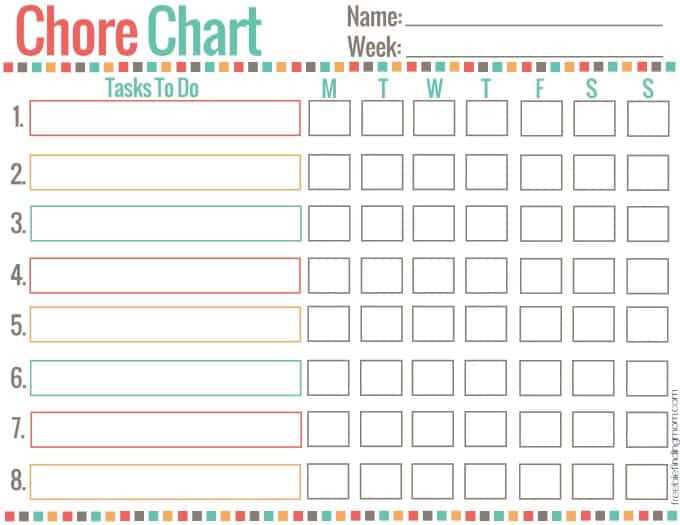
Download a ready-to-use household task schedule in A4 or US Letter format and assign 5–7 clearly defined duties per person each week. For children aged 4–6, include simple actions such as putting toys away, watering plants, or placing laundry in a basket. For ages 7–10, add table setting, pet feeding, or sweeping small areas. Teenagers can handle vacuuming, dishwashing, trash removal, and basic meal prep. Limiting the list to a manageable number of responsibilities increases completion rates and reduces skipped assignments.
Design the layout with daily checkboxes (Monday–Sunday) and a dedicated column for signatures or initials. This visual accountability system increases follow-through by making progress measurable. Use bold section headers like Morning, After School, and Evening to group activities by time block. For younger children, add icon markers (bed, broom, plate) next to each duty to improve clarity and independence.
Incorporate a simple reward structure tied to consistency: for example, 20 completed tasks per week can equal extra screen time or a small allowance bonus. Keep the design black-and-white to reduce ink usage and allow customization with markers or stickers. Laminate the sheet or place it in a transparent sleeve to reuse it with dry-erase markers, reducing paper waste while maintaining structure throughout the month.
Review the schedule every Sunday evening and adjust assignments based on school workload, extracurricular activities, and family events. Rotating responsibilities weekly prevents monotony and helps children develop a broader range of practical skills, from kitchen hygiene to room organization. A clearly structured responsibility tracker transforms daily maintenance from constant reminders into a visible, shared system.
What Is a Free Printable Chore Chart and Who It’s Best For
Use a ready-to-download household task tracker if you need a clear system that shows who does what and when. It is a formatted worksheet–usually a one-page PDF–with rows for names, columns for duties, and checkboxes for daily or weekly completion. Many versions include predefined task lists by age group (ages 4–6: put toys away, feed a pet; ages 7–10: vacuum a room, load the dishwasher; teens: laundry, meal prep), plus space for deadlines and reward points. The layout is designed for standard A4 or US Letter paper, so it can be printed at home without resizing.
This type of responsibility planner works best for families with children aged 4–16 who respond to visual structure and measurable goals. It suits parents who want a screen-free management tool that can be placed on a fridge or bulletin board and reviewed in under two minutes each day. Teachers and caregivers in small groups (up to 10 children) also use similar sheets to assign classroom duties such as board cleaning or supply organization. It is practical for households that rotate responsibilities weekly, track allowance based on completed duties, or need a shared overview that reduces repeated verbal reminders.
A paper-based duty schedule is also suitable for adults sharing an apartment, especially in flats with 2–4 roommates where cleaning conflicts are common. A visible grid with fixed assignments–bathroom on Mondays, trash on Wednesdays, kitchen deep-clean on Sundays–limits ambiguity and documents accountability without apps or subscriptions. People who prefer handwriting over digital planners, families limiting device time, and households without consistent internet access benefit most from this structured yet low-cost coordination tool.
How to Choose the Right Printable Chore Chart Format by Age (Toddlers, Kids, Teens)
Choose a visual task board with large icons and no more than 3–5 daily items for toddlers (ages 2–4); use photos or simple illustrations (toys in a bin, toothbrush, pajamas) and add Velcro or checkbox circles sized at least 1 inch for small hands. For ages 5–9, switch to a weekly grid with clear text labels, 6–8 responsibilities per week, and measurable outcomes such as “make bed (blanket pulled up, pillow straight)” or “feed pet (1 scoop).” Include a small reward tracker with 5–10 points leading to a predefined privilege. Teens (13–18) respond better to a responsibility matrix listing task frequency (daily/weekly/monthly), time estimate (15–60 minutes), and consequence rules; avoid stickers and use signature lines for accountability.
Match the layout complexity to reading level and independence. Preschoolers need single-column layouts with one task per row and visual cues; elementary children manage multi-column weekly planners with checkmarks and deadline boxes; teenagers benefit from contract-style sheets that outline standards and review dates. Use landscape orientation for shared family boards and portrait for personal planners stored in binders. Paper size should fit common home printing (US Letter or A4), and font size should not drop below 18 pt for early readers or 11–12 pt for teens.
| Age Group | Recommended Layout | Task Volume | Tracking Method | Update Frequency |
|---|---|---|---|---|
| 2–4 years | Single-column with icons | 3–5 per day | Stickers / large check circles | Daily reset |
| 5–9 years | Weekly grid (Mon–Sun) | 6–8 per week | Checkbox + point counter | Weekly review |
| 10–12 years | Two-column planner (task + deadline) | 8–12 per week | Initials + progress bar | Weekly review |
| 13–18 years | Responsibility matrix | 10–15 mixed frequency | Signature + consequence note | Biweekly or monthly review |
Adjust complexity every 12–18 months based on consistency: if completion rate stays above 80% for four consecutive weeks, add one new responsibility or increase independence (for example, replace “clean room” with a checklist of 4 standards). If completion drops below 50%, reduce task count or split larger duties into 10–20 minute segments.
Where to Download High-Quality Free Printable Chore Charts (PDF & Editable Templates)
Download ready-to-use household task planners in PDF and editable formats from trusted template platforms such as Canva, Template.net, and Vertex42. These sites provide A4 and US Letter layouts, fillable fields, and customizable color schemes without watermarks or forced subscriptions.
- Canva – Offers fully customizable responsibility trackers with drag-and-drop editing. Export as PDF for print or share digitally. Many designs include sections for weekly goals, reward systems, and signature fields.
- Template.net – Provides structured duty schedules in Word, Excel, and PDF formats. Files are downloadable without mandatory registration in many cases, and layouts include daily, weekly, and monthly grids.
- Vertex42 – Specializes in Excel-based household management sheets. Ideal for families who want automatic progress tracking and editable task rotation tables.
- 101Planners – Supplies minimalist black-and-white task organizers in multiple styles, including blank, prefilled, and age-specific layouts.
- MaplePlanners – Features clean responsibility sheets with dedicated columns for allowances, completion checkmarks, and parent approval signatures.
For editable versions, prioritize DOCX and XLSX formats if you need task rotation, automated totals, or personalized reward tracking. PDF files are preferable for quick distribution and consistent formatting across devices. Before downloading, verify paper size compatibility (A4 vs. US Letter), margin settings, and whether the layout supports handwriting or digital input. Select designs with clear grid spacing (at least 0.5-inch row height for handwriting) and high-resolution vector elements to prevent pixelation during printing.
How to Customize a Printable Chore Chart for Daily, Weekly, and Monthly Tasks
Define three separate sections for daily, weekly, and monthly responsibilities and assign each a distinct color code (for example: blue for daily, green for weekly, orange for monthly). Limit the daily block to 5–7 repeatable actions such as “make bed,” “wash dishes,” or “15-minute room reset,” each with a checkbox column for Monday through Sunday. Weekly duties should appear in a single-row format with a specific weekday assigned (e.g., vacuum on Saturday, laundry on Wednesday). Monthly items require a date field instead of weekday tracking to avoid clutter.
Adjust task frequency using measurable criteria. If a task takes less than 10 minutes, place it in the daily column; 15–40 minutes belongs in the weekly section; anything exceeding 45 minutes or requiring supplies (deep-clean fridge, rotate mattresses, clean windows) fits monthly. This time-based structure prevents overloading one timeframe and keeps expectations realistic for children and adults.
Personalize rows by age group or household role. For children ages 4–6, use icons and limit text to two-word phrases. Ages 7–10 can handle multi-step duties listed with bullet-style micro-steps (e.g., “Sort laundry → Load washer → Start cycle”). Teenagers and adults should receive outcome-based descriptions such as “Bathroom reset: mirror, sink, toilet, floor.” Keep font size no smaller than 12 pt for readability.
Add a performance tracking strip. Insert a narrow column at the far right for scoring (1–3 scale) or initials for accountability. For shared households, include a rotating assignment line labeled “This Week’s Lead” to distribute oversight evenly. If using lamination, leave 1.5 cm margin spacing around edges to prevent checkbox cutoff after trimming.
Integrate flexibility by reserving two blank lines in each timeframe for seasonal or temporary responsibilities. Examples: “Holiday decorations setup” (monthly), “Yard leaf removal” (weekly during autumn), or “Exam prep review” (daily during school finals). Avoid rewriting the entire sheet; swap only the adjustable rows while keeping the structure intact.
Test the layout for two full weeks and track completion rate. If fewer than 70% of boxes are marked, reduce task count by 20% or redistribute heavy duties across more days. If completion exceeds 90% consistently, add one progressive item per category to maintain momentum without overwhelming participants.