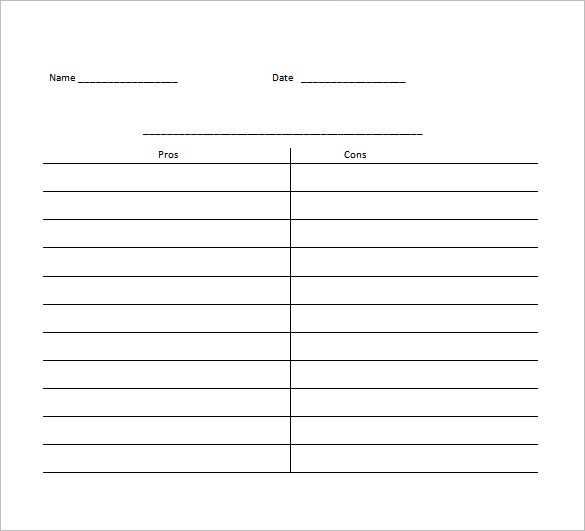
Use a two-field comparison grid when you need a clear visual split between paired ideas, metrics, or attributes. A vertically divided layout with equal-width sections (50% / 50%) on A4 or US Letter paper provides balanced space for parallel entries such as pros and cons, planned vs. actual results, features vs. specifications, or questions vs. answers.
Design the page with a visible center divider line of 1–1.5 pt thickness and outer margins of at least 15 mm to allow hole punching without covering content. Allocate 8–12 horizontal rows depending on handwriting size; for classroom use, row height of 12–14 mm supports legibility for middle and high school students. Add bold section headers at the top of each half using 14–16 pt font for print clarity.
For analytical tasks, include a narrow header strip above both sections for the topic title and date. In project tracking, reserve the left side for planned tasks and the right side for status updates with checkboxes aligned to the right edge. When used in meetings, label sides as Arguments For and Arguments Against and leave at least 30% of vertical space free for spontaneous notes.
Export the layout as a high-contrast PDF in black and white to ensure sharp reproduction on standard office printers (300–600 dpi). Avoid background shading below 10% gray to prevent toner overuse. Keep line spacing consistent across rows to maintain visual rhythm and reduce scanning time during review sessions.
This structured sheet suits academic comparison essays, product feature breakdowns, budget planning (income vs. expenses), and decision matrices. A simple two-part grid eliminates visual noise and directs attention to side-by-side evaluation, making discrepancies and alignments immediately visible.
What Is a Printable Blank 2 Column Chart Template and When to Use It
Use a two-field comparison sheet when you need a fast visual split between related ideas, options, or data points on paper. This layout places paired information side by side, reducing eye movement and helping readers detect differences, similarities, and cause-effect links without scanning multiple pages.
A two-section grid is a structured worksheet divided vertically into equal parts, usually with a header row and multiple horizontal lines for entries. It may include a title area at the top, labeled headings such as Pros and Cons, Question and Answer, or Term and Definition. Standard letter size (8.5 × 11 inches) or A4 format is commonly used, allowing 20–40 paired rows depending on line spacing (0.25–0.35 inches per row).
Teachers apply this format for vocabulary drills, historical comparisons, and experiment observations. For example, in a biology class, students may record organism in the left field and characteristics in the right, fitting up to 30 entries per page. In literature analysis, one side lists quotes, the other side explains themes or rhetorical devices, keeping interpretation aligned directly with source text.
Business settings benefit from this side-by-side layout during vendor evaluations, risk assessments, and meeting preparation. A manager can list suppliers on the left and pricing details or delivery terms on the right, allowing quick scoring or highlighting. In SWOT-style reviews, strengths appear opposite weaknesses, enabling direct comparison during strategy discussions.
Students preparing for exams often divide concepts and key facts across the page to reinforce recall. Writing a formula on one side and its practical example on the other supports active testing: cover one half and attempt to reproduce the hidden information. This approach increases retention by linking paired data in a single visual frame.
Project planners use this format for task tracking. One field contains action items; the adjacent field tracks deadlines or responsible persons. With 25–35 rows available, a weekly plan fits on a single sheet, making it suitable for clipboards, binders, or wall boards in offices and classrooms.
Handwritten comparison tables are also practical during interviews or research. A journalist may record questions on the left and summarized responses on the right, maintaining alignment between inquiry and statement. The same structure supports usability testing: feature names on one side, user feedback on the opposite side.
Select this paired-layout worksheet whenever clarity depends on direct visual alignment rather than long paragraphs. It works best for binary contrasts, matched data sets, structured note-taking, and quick paper-based analysis where screen devices are impractical or restricted.
Key Elements to Include in a Functional 2 Column Chart Layout
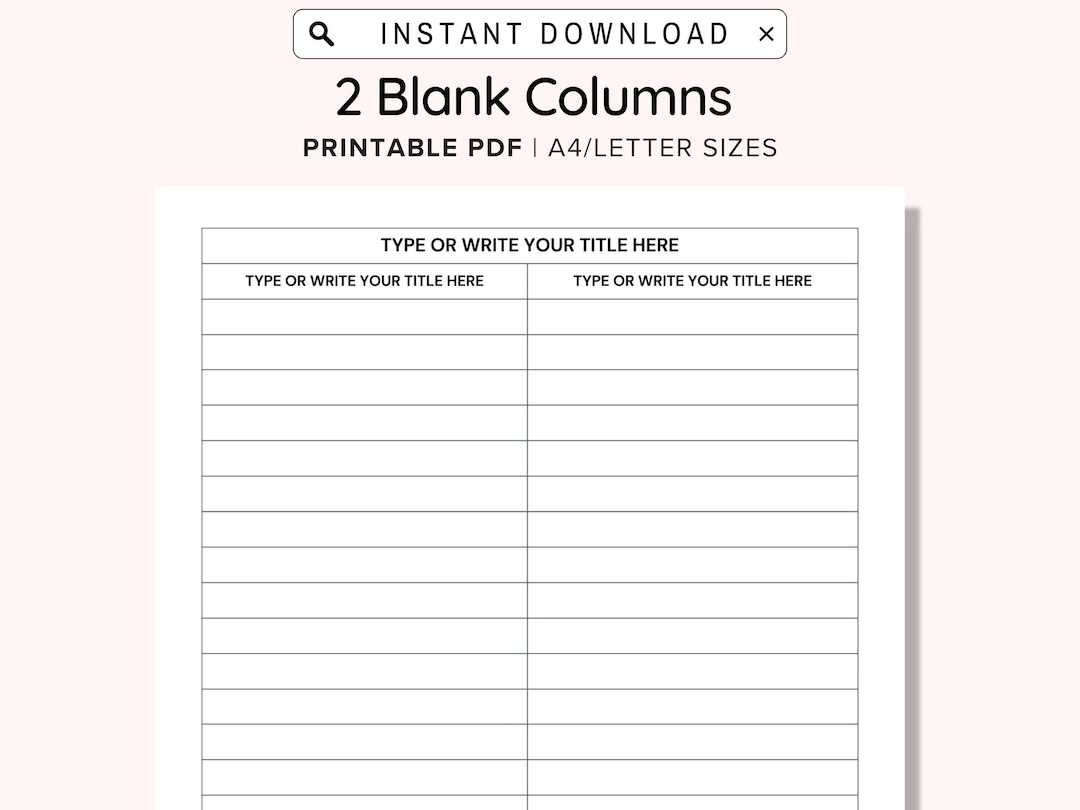
Define a clear purpose for each side before adding any data: the left area should contain categories, questions, or criteria, while the right area should present corresponding values, explanations, or comparisons. Keep the width ratio close to 40/60 when text dominates, or 50/50 for balanced comparisons. Maintain a minimum inner margin of 0.5 inches on all sides to prevent crowding during printing. Use a consistent header row with bold labels sized 14–16 pt, while body text should remain between 10–12 pt for readability.
Use precise alignment rules to improve scanning speed. Left-align text entries and right-align numerical values to create a visual anchor for figures. Apply horizontal separators at 0.75–1 pt thickness to distinguish rows without overwhelming the layout. Limit each row to a single idea; if an explanation exceeds 20–25 words, split it into multiple lines with consistent spacing of 1.15–1.5 line height. Avoid vertical grid lines unless the page includes more than 15 rows, where faint dividers (10–15% black) can prevent misreading.
Introduce hierarchy through typographic contrast rather than decorative elements. Use bold for section breaks and italic only for short clarifications. Restrict font families to one serif or one sans-serif typeface to maintain visual order. If color is used, limit it to headers or key figures and ensure a contrast ratio of at least 4.5:1 for accessibility compliance. Monochrome layouts reproduce more reliably on standard office printers.
Plan for handwriting if the layout will be filled manually. Provide a minimum row height of 0.4 inches for short notes and 0.6 inches for extended responses. Leave at least 0.25 inches of spacing between rows to prevent overlap. For structured evaluation sheets, include checkboxes sized 0.2–0.25 inches aligned consistently within the value area.
Conclude the page with a dedicated notes section spanning the full width of the sheet. Allocate 15–20% of the vertical space for remarks, totals, or follow-up actions. If totals are calculated, reserve a distinct row with heavier border weight (1.5 pt) to separate summary data from regular entries. A carefully measured grid, controlled typography, and predictable spacing ensure clarity under repeated use.
How to Format a 2 Column Chart Template for Print (Margins, Orientation, Spacing)
Set page margins to 0.5–0.75 inches on all sides to balance writing space and printer limitations. Most desktop printers cannot print closer than 0.25 inches to the paper edge, so anything tighter risks clipping. For A4 (210 × 297 mm), use 15–20 mm margins; for US Letter (8.5 × 11 inches), keep at least 0.5 inches. If the sheet will be hole-punched for a binder, increase the left margin to 1 inch (25 mm) to prevent text loss.
Select portrait orientation for lists with short entries and landscape for wider handwriting or numeric comparisons. Portrait works best when each section contains brief phrases under 6–8 words per line. Landscape is better when users need 12–15 words per line or larger handwriting areas for meetings and classroom activities. Switching orientation changes usable width significantly: US Letter portrait provides about 7.5 inches of writable width (with 0.5-inch margins), while landscape offers roughly 10 inches.
Divide the writable width into two equal sections with a central gap of 0.3–0.5 inches (8–12 mm). This inner spacing prevents visual merging of content and gives room for vertical divider lines if required. Avoid placing the divider exactly at 50% without accounting for the gap; instead, subtract the gap from total writable width, then split the remainder evenly. For example, with 7.5 inches usable width and a 0.5-inch center gap, allocate 3.5 inches to each side.
Use line spacing of 1.2–1.4 for typed text and 0.3–0.4 inches between horizontal rules if the sheet is meant for handwriting. For structured note-taking, 0.35-inch line intervals (about 9 mm) suit standard pen writing. If targeting younger students, increase to 0.4–0.45 inches. Keep vertical padding above and below section headers at 0.25 inches to separate them from the writing area.
Choose a readable font between 10–12 pt for body text and 13–16 pt for headings. Avoid condensed typefaces; they reduce legibility after printing. Black or 90% gray text ensures clarity without oversaturation. If adding grid lines or dividers, use 0.5–0.75 pt stroke weight so lines remain visible but do not dominate handwritten input.
Align content consistently: left alignment for text entries, right alignment for numeric data, and centered headers. Maintain identical top baselines across both sections to prevent visual imbalance. If adding row guides, ensure they extend only within their respective areas and do not cross the center gap unless a continuous comparison row is required.
Before final output, export to PDF at 300 DPI and disable automatic scaling in the print dialog. Verify that “Actual Size” or 100% scale is selected; scaling alters spacing and alignment. Print a single test page and measure margins with a ruler to confirm accuracy within ±1 mm. Adjust document settings rather than printer scaling if corrections are needed.