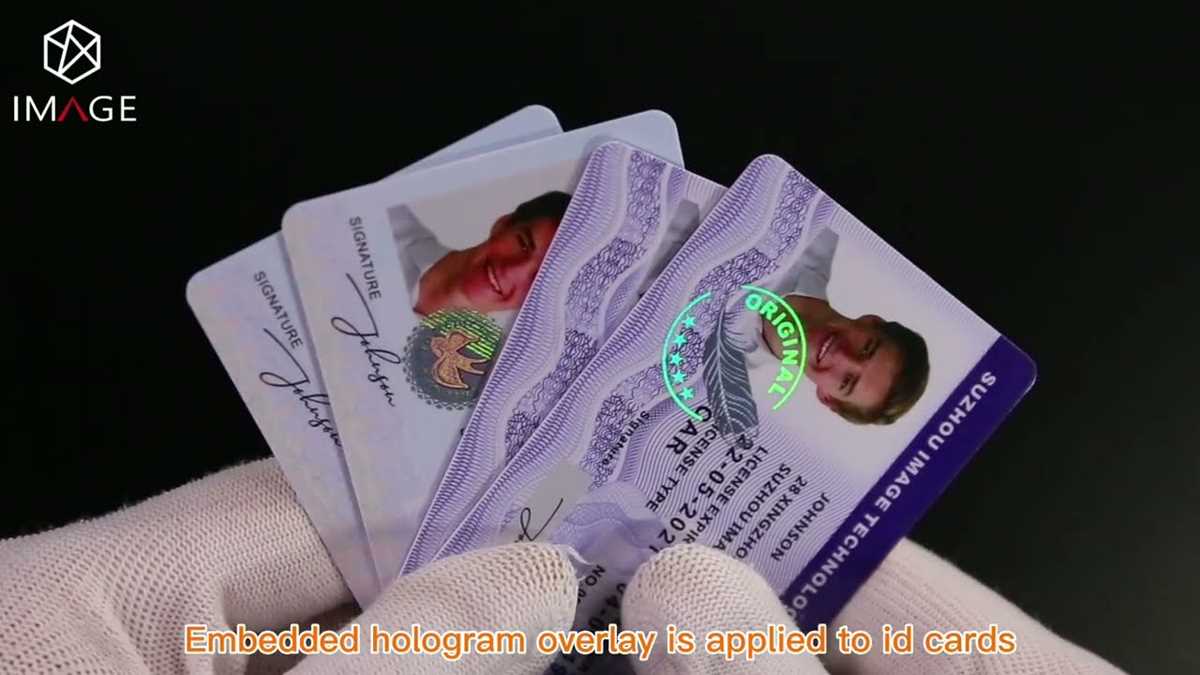
Choose a diffractive overlay with microtext and serialized coding to prevent unauthorized duplication of identification cards. Modern ID credentials require multi-layered visual authentication that combines reflective patterns, nano-engraved lines, and variable optical imagery visible under different light angles. A properly engineered overlay film integrates guilloché structures, hidden alphanumeric strings, and UV-reactive fibers, reducing the probability of counterfeit reproduction by more than 80% compared to standard laminate solutions.
Advanced optically variable patches use diffraction gratings with line densities exceeding 1,500 lines per millimeter, making replication with consumer-grade equipment nearly impossible. For corporate badges and governmental IDs, select polyester-based films with a thickness of 12–23 microns and heat-activated adhesive layers calibrated between 95–120°C. This range ensures strong bonding without distorting PVC or composite card substrates.
Serialized numbering combined with QR or Data Matrix encoding strengthens traceability. Each overlay can incorporate laser-etched identifiers linked to a secure database, enabling instant verification through handheld scanners. For small and mid-volume production, desktop-compatible transfer sheets optimized for dye-sublimation and retransfer printers maintain clarity of optical elements while preserving fine-line resolution below 50 microns.
For maximum durability, apply abrasion-resistant coatings rated above 4H pencil hardness and test finished cards under 500-cycle bend simulations. Integrating tamper-evident fracture patterns ensures that any removal attempt leaves visible damage, discouraging reuse. Proper calibration of lamination pressure–typically 0.3–0.6 MPa–maintains optical sharpness and structural integrity across large issuance batches.
Security ID Hologram Printable: Practical Guide to Design, Printing, and Protection
Use a vector-based layout with layered microtext (0.5–0.8 pt), guilloche patterns, and variable serial numbering generated through a secure database to prevent duplication. Apply diffraction foil with dot-matrix or 2D/3D imagery at 1200–2400 dpi resolution; lower settings blur fine lines and reduce anti-counterfeit performance. For ID badges, select polyester or polycarbonate substrates (125–250 microns) instead of standard PVC if long-term durability and heat resistance are required. Combine UV-reactive inks (365 nm activation), latent flip images, and nano-engraved elements smaller than 50 microns to create multi-level verification. During production, maintain controlled humidity below 55% to avoid adhesive distortion, and calibrate foil stamping pressure between 40–60 psi to preserve fine diffraction detail. Always proof under angled white light (45°) and UV exposure before batch output.
Protect finished labels with tamper-evident backing that fractures on removal, such as destructible vinyl or void-pattern adhesive films leaving a residue message. Integrate QR or Data Matrix codes linked to encrypted verification portals with time-stamped validation logs. Store master artwork in offline encrypted storage (AES-256 standard) and restrict RIP software access through hardware authentication keys. For distribution control, assign batch identifiers tied to issuance records and audit monthly for serial gaps exceeding 0.5% of total volume. Combine physical diffraction elements with serialized tracking to reduce cloning risks and simplify authenticity checks at checkpoints.
How to Choose the Right Printable Hologram Material for Security ID Cards
Select a polyester-based overlay with embedded diffraction patterns and a thickness of 25–50 microns for ID cards exposed to daily wear. PET film offers high tear resistance (over 150 MPa tensile strength) and maintains optical clarity after lamination at 110–130°C. For cards used more than 200 times per day (access control, transport passes), choose a variant with scratch-resistant coating rated at least 3H pencil hardness to prevent surface degradation and distortion of the optical image.
Match the overlay type to the printing method. For dye-sublimation printers, use heat-activated adhesive layers compatible with 0.76 mm PVC cards to prevent bubbling during thermal transfer. For retransfer printers, select a thin diffraction film designed for reverse printing technology, ensuring proper adhesion between the transfer layer and the card core. Inkjet-compatible films require microporous receptor coatings to maintain ink anchoring without bleeding. UV printing systems demand corona-treated surfaces with surface energy above 38 dyn/cm for stable ink bonding.
Verify optical complexity and anti-counterfeit structure before purchasing bulk quantities:
- 2D/3D visual depth with microtext smaller than 0.3 mm
- Guilloche patterns integrated into the reflective layer
- Covert elements visible under 365 nm UV light
- Serial numbering or laser-readable nano-engraving
- Destructible adhesive that leaves residue upon removal
Environmental resistance must align with card usage conditions. For outdoor badges, select films tested between –30°C and +80°C with humidity tolerance up to 95% RH. Chemical resistance to isopropyl alcohol and mild detergents prevents optical fading during cleaning. If cards are frequently bent, choose a flexible overlay with elongation at break above 80% to avoid cracking along edges.
Request certification data and lifecycle testing results from suppliers. Look for compliance with ISO/IEC 7810 ID-1 standards for card dimensions and lamination behavior. Conduct internal abrasion testing (at least 500 cycles using a Taber abrasion tester, CS-10 wheel, 500 g load) before deployment. Small pilot batches of 100–300 units allow validation of print alignment, adhesion strength (minimum 6 N/25 mm peel strength), and long-term optical stability under real operational stress.
Technical Requirements for Printing Holographic Security Elements on PVC and PET Cards
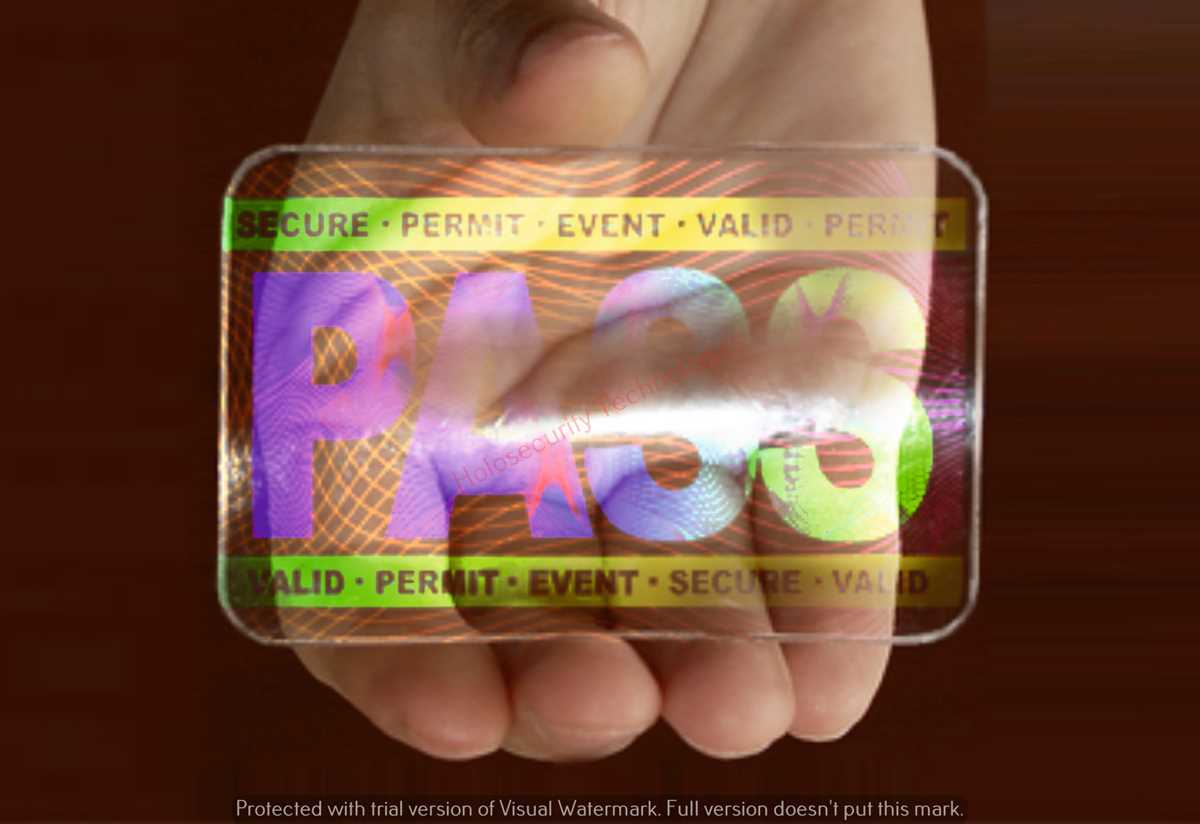
Use a UV offset or screen press with a minimum native resolution of 1200 dpi and register tolerance within ±0.05 mm to apply diffractive foil elements on PVC and PET substrates. Sheet flatness deviation must not exceed 0.3 mm per 100 mm length to prevent distortion of microtext and guilloche lines below 80 microns. For PVC cards (0.76 mm ISO/IEC 7810 ID-1 format), maintain substrate surface energy above 38 dyn/cm to ensure adhesion of metallized transfer layers. PET requires corona treatment up to 42 dyn/cm and controlled preheating at 50–60°C before lamination to avoid silvering and delamination of optically variable patches.
Adhesive and Lamination Parameters: Apply hot-stamp foil at 110–130°C with pressure between 2.5–4.0 MPa and dwell time of 0.4–0.8 seconds. Excess pressure deforms microstructures and reduces diffraction clarity; insufficient pressure leads to edge lifting after 500+ bending cycles. For overlay lamination, use transparent films of 50–100 microns thickness with haze below 3% (ASTM D1003) to preserve light refraction patterns. Lamination temperature for PVC: 130–150°C; for PET: 160–180°C with gradual cooling under 0.5 MPa to minimize internal stress. Registration marks must be read by optical sensors with ±0.03 mm accuracy for multi-layer alignment.
Optical and Durability Control: Diffractive zones should maintain reflectivity variation of at least 60% between viewing angles of 15° and 45° under D65 illumination. Micro-embossed structures must have relief depth between 0.2–0.5 microns to retain interference effects after abrasion testing (Taber CS-10F, 500 cycles, 500 g load). Chemical resistance must withstand 95% ethanol exposure for 60 seconds without foil degradation. Cards must pass ISO/IEC 10373 bending (1000 cycles, 20 mm deflection) and torsion tests without cracking of metallized layers or loss of optical variability.
Designing Tamper-Resistant Holographic Layouts with Microtext, Guilloché, and Serial Data
Define a layered structure where microtext bands, guilloché meshes, and serialized elements intersect at controlled angles of 15–30° to prevent clean separation during peeling. Place microtext along curved vectors rather than straight baselines; character height should range between 80–150 microns, with stroke width below 20 microns to ensure that duplication attempts result in fill-in or blur. Avoid uniform spacing–introduce ±5% kerning variation to create optical noise detectable under 10× magnification.
Integrate guilloché networks with at least three overlapping mathematical curves generated from different parametric equations (e.g., hypotrochoid, epitrochoid, and Lissajous forms). Line thickness must vary from 25 to 60 microns within a single pattern cycle. Embed microtext directly into selected curve paths so that the letterforms follow the oscillation of the line; this reduces the risk of vector recreation. Maintain a minimum intersection density of 12 crossings per square millimeter to increase distortion under scanning.
Serial data should not sit in isolated blocks. Distribute variable numbers across multiple zones, partially masked by diffraction motifs or fine-line gradients. Use dual serialization: visible alphanumeric codes (OCR-B, 0.8–1.2 mm height) combined with covert micro-engraved numeric strings under 200 microns. Synchronize both sequences algorithmically so mismatches expose substitution attempts. Below is a recommended serialization structure:
| Layer | Character Height | Font Type | Function |
|---|---|---|---|
| Primary Visible Code | 1.0 mm | OCR-B Modified | Automated scanning |
| Secondary Micro Code | 120 µm | Custom Sans Micro | Forensic verification |
| Latent Numeric Track | 90 µm | Condensed Serif | Tamper indication |
Introduce destructive registration traps by aligning guilloché endpoints exactly at die-cut or adhesive transition zones. If removal occurs, the pattern breaks visibly due to micron-level misalignment. Set tolerance for radial symmetry deviation below 0.03 mm; any replication beyond this threshold produces noticeable discontinuity under 20× inspection.
Apply gradient diffraction backgrounds with controlled spatial frequency shifts between 300 and 600 lines per inch. Overlay microtext in negative (knockout) mode inside these gradients. The contrast ratio should remain between 1.5:1 and 2.5:1 under white LED illumination to maintain readability while resisting flatbed capture.
Use randomized micro-perforation anchors beneath selected serial digits. Hole diameter should not exceed 70 microns, spaced irregularly within a 0.4 mm radius cluster. The perforation map must correlate with the final two digits of the serial sequence, forming a physical–data linkage that cannot be replicated without matching tooling geometry.
Incorporate kinetic fine-line arrays that shift color or intensity at viewing angles between 30° and 60°. Position these arrays beneath microtext corridors so that attempted abrasion disrupts both optical motion and typographic continuity. Maintain angular line deviation within ±0.5° across the sheet to prevent moiré drift.
Validate the layout using three-stage inspection: 10× optical check for microtext clarity, 365 nm UV response for hidden serial ink alignment, and cross-polarized light to detect lamination stress. Reject any batch where guilloché node displacement exceeds 0.05 mm or where microtext legibility drops below 95% character recognition under calibrated magnification.