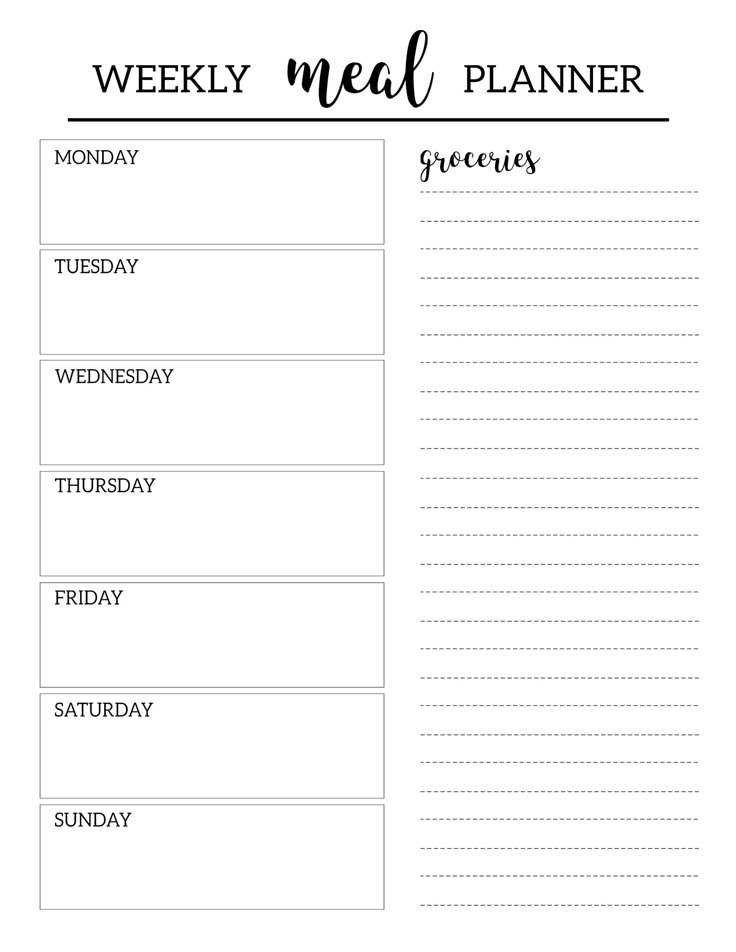
Allocate 30 minutes every Sunday to map out dishes for the next 7 days and reduce grocery spending by up to 20% while cutting daily cooking time by 40–60 minutes. A structured meal schedule in A4 or US Letter format allows you to see breakfasts, lunches, dinners, and snacks at a glance, preventing duplicate purchases and last-minute takeout orders.
A well-designed menu organizer should include clearly divided sections for each day, a separate grocery checklist, and a notes column for leftovers or batch-cooked items. The most practical layouts use horizontal rows for days (Monday–Sunday) and vertical columns for meal categories. Leave at least 2–3 cm of writing space per cell so handwritten entries remain readable after printing in black and white.
For families of 3–5 people, dedicate one line per meal with portion indicators such as “x4” to simplify shopping calculations. Add a small prep column to mark actions like defrosting, soaking beans, or marinating meat. This reduces forgotten steps and shortens weekday kitchen prep by up to 25%.
Choose a clean PDF template with high-contrast typography (12–14 pt font) to ensure clarity on standard home printers. Avoid heavy graphics to save ink. Keep margins at 1.5–2 cm to allow hole punching for binders. A structured 7-day meal chart becomes a practical kitchen tool that supports budget control, balanced nutrition, and predictable grocery routines.
Weekly Food Planner Printable: Practical Structure and Usage Guide
Allocate one A4 page per 7-day cycle with a fixed grid: 7 columns (Mon–Sun) × 4 rows (breakfast, lunch, dinner, snacks) plus a right-side column for quantities and notes. Leave a 3–4 cm bottom section for a categorized shopping list divided into produce, proteins, grains, dairy, pantry. Add a small header block with calorie target (e.g., 1,800 kcal/day), number of servings per dish, and prep time in minutes. Use checkboxes next to each meal slot to mark preparation status and a thin margin on the left for batch-cooking indicators (B) and leftovers (L). Keep line height at 1.2–1.3 for handwriting clarity and use 11–12 pt font if you plan to type entries before printing.
Fill the grid by assigning 2–3 repeatable base dishes per category to reduce cost and prep time. For example, schedule two large-batch dinners (4–6 portions each) on Sunday and Wednesday, then distribute leftovers across adjacent days. Balance macronutrients visually: aim for protein in at least 18–25 g per main meal, vegetables covering half of the plate for lunch and dinner, and limit high-sugar snacks to one slot per day. In the notes column, record exact quantities such as “chicken breast 1.2 kg” or “brown rice 500 g” to generate a precise shopping list without recalculating later.
Review the sheet every Saturday evening: cross out completed dishes, highlight items not cooked, and transfer unused ingredients to the next 7-day grid. Archive past pages in a binder to track spending patterns and menu rotation over 4–6 weeks. This paper-based layout supports quick visual scanning, minimizes impulse purchases, and keeps meal preparation aligned with budget and nutrition targets.
How to Structure a Weekly Food Planner Printable for Breakfast, Lunch, Dinner, and Snacks
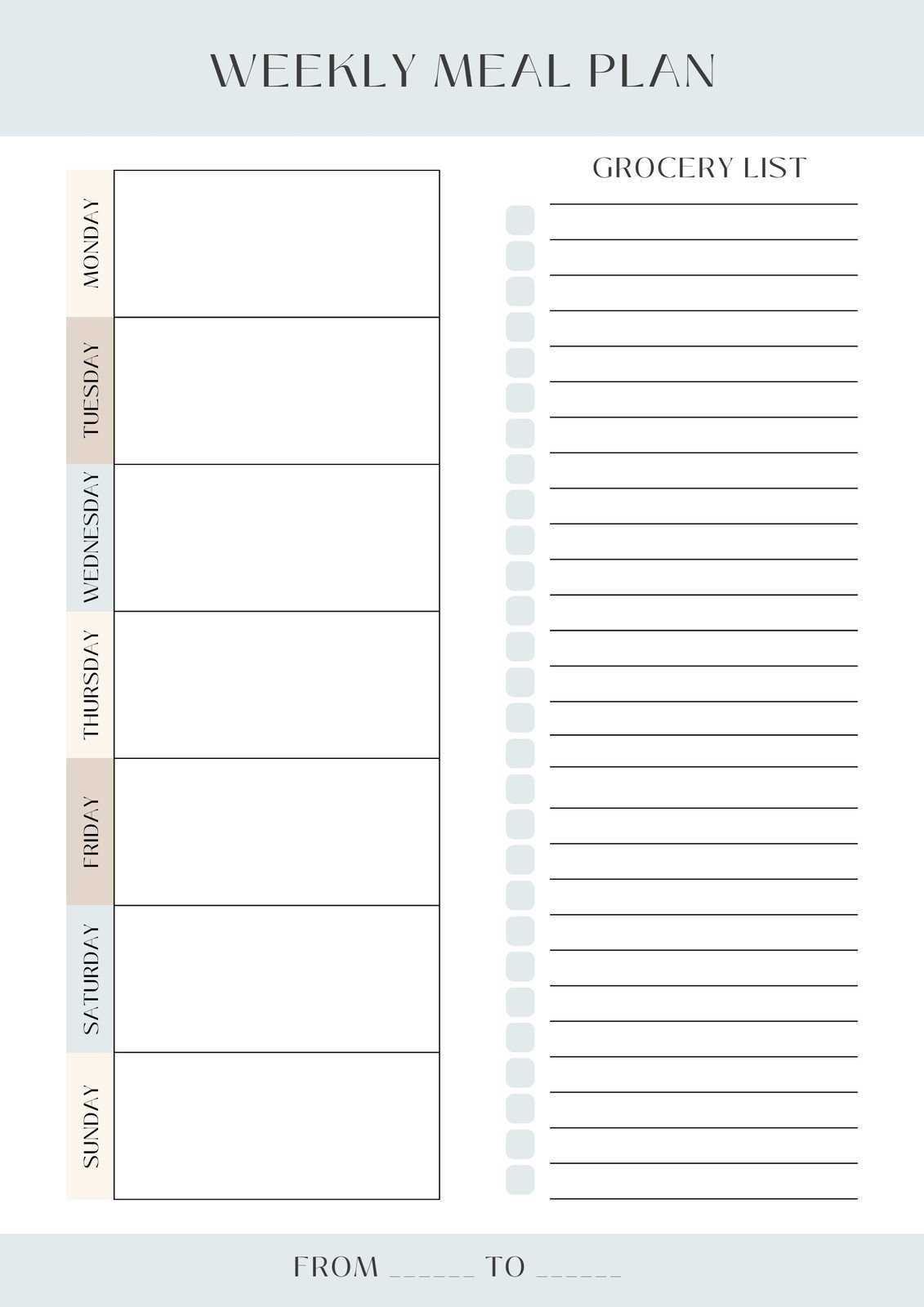
Divide the page into four fixed columns labeled Breakfast, Lunch, Dinner, and Snacks, and seven horizontal rows for each day from Monday to Sunday. Keep each cell at least 4 × 4 cm on A4 paper so handwritten entries remain readable. Reserve a narrow margin (2–3 cm) on the right for notes such as prep time, calories, or grocery reminders. This grid layout prevents overcrowding and keeps all meals visible at a glance without flipping pages.
Allocate space proportionally based on meal complexity. Dinner cells should be 20–30% taller than breakfast cells to fit ingredients or cooking steps. Snacks can share one combined box per day divided into two smaller lines for mid-morning and evening bites. If calorie tracking is required, add a thin row under each day with four small fields for numeric totals.
Use structured prompts inside each section instead of blank space:
- Main dish: primary item (e.g., oatmeal, grilled chicken)
- Side: vegetables, fruit, or grains
- Beverage: water, tea, smoothie
- Prep time: 10 min / 30 min / 1 hr
This guided format reduces vague entries like “something quick” and increases clarity during grocery shopping.
Add a dedicated preparation tracker below the main table. Create three checkboxes per day:
- Ingredients purchased
- Items prepped (washed, chopped, marinated)
- Leftovers stored
Position this tracker directly under each weekday column rather than at the bottom of the sheet to keep related actions visually connected.
Incorporate a categorized grocery strip aligned with meal distribution. Divide it into Proteins, Vegetables & Fruit, Grains, Dairy/Alternatives, and Extras. Leave 6–8 lines under each category. This arrangement mirrors how supermarkets are organized and reduces redundant purchases. Place this list on the lower third of the page so the main meal grid remains dominant.
Use visual cues to differentiate meal types without clutter. Apply light shading (5–10% gray) to lunch rows and dotted borders for snacks. Choose a readable sans-serif font at 11–12 pt for labels and 14 pt bold for section titles. Maintain consistent spacing of 8–10 mm between rows to avoid cramped writing. Keep the entire layout to a single page to support quick reference on a fridge door or clipboard.
What Sections to Include: Grocery List, Pantry Inventory, and Meal Prep Notes
Add a structured grocery list divided into precise categories: produce, proteins, dairy, grains, frozen items, and household staples. Place checkboxes next to each line and include a quantity column (e.g., “6 eggs,” “500 g chicken breast,” “2 cans 400 g tomatoes”). Leave a narrow margin for price tracking to monitor spending per item and compare totals across different stores. A separate “priority” marker helps identify ingredients needed within 48 hours.
Include a pantry inventory table with columns for item name, package size, remaining amount, and expiration date. For example, record “Brown rice – 1 kg bag – 300 g left – 08/2026.” This prevents duplicate purchases and reduces expired goods. Arrange items alphabetically or by shelf location to match your storage layout, which speeds up stock checks to under five minutes.
Reserve space for freezer tracking with clear labeling of portion counts. Note preparation date and portion size, such as “Beef stew – 3 portions – 250 g each – cooked 12 Feb.” Add a “use by” reminder set at three months for cooked dishes and six months for raw proteins. This section reduces waste and keeps rotation consistent.
Integrate a meal prep notes block with three subsections: batch cooking tasks, ingredient prep, and storage instructions. Specify measurable actions like “Chop 1 kg carrots,” “Marinate chicken 12 hours,” or “Cook quinoa – 2 cups dry.” Add container size references (750 ml glass box, 1 L jar) to ensure correct storage planning.
Insert a leftovers tracker with a simple two-column format: dish name and deadline. Write “Roasted vegetables – consume by Thursday.” This prevents forgotten containers at the back of the refrigerator and supports structured reuse, such as turning baked salmon into wraps or grain bowls.
Add a substitution log directly under the grocery list. Record swaps like “Greek yogurt instead of sour cream” or “Black beans instead of chickpeas.” Over time, this builds a personalized ingredient database aligned with dietary preferences, allergies, or budget limits.
Provide a budget summary box at the bottom of the page. Include estimated total, actual total, and price difference. If your target is $120 and you spend $134, the $14 gap becomes visible immediately. Pair this with a short reflection line to identify cost drivers such as specialty cheeses or imported produce.
End with a notes section for timing and coordination: cooking durations, oven temperature references, and reheating instructions. Example: “Bake lasagna at 180°C for 35 min; reheat portion at 160°C for 15 min.” Clear operational details reduce guesswork and keep meal execution consistent throughout the week.
How to Design a Printable Layout That Fits on One Page Without Looking Cluttered
Use a clear grid with fixed proportions: allocate 60–65% of the page width to the main meal matrix and 35–40% to notes, shopping items, or prep tasks. Set margins to 0.5–0.7 inches to preserve writing space while preventing edge crowding. Limit the design to two font families: one sans-serif (10–11 pt) for entries and one slightly heavier style (12–14 pt) for section headers. Keep line height at 120–130% to avoid dense text blocks. Replace heavy borders with 0.5 pt hairlines or subtle gray (#BFBFBF) dividers to visually separate days without overwhelming the page. If including seven days with three meals each, use evenly sized cells of at least 1.2 x 1.5 inches to ensure handwriting remains legible.
Reduce visual noise by eliminating decorative elements that do not serve structure: no background patterns, no more than one accent color, and no shadows. Align all text to a single axis; mixed alignment fragments the composition. Group related elements using consistent spacing increments such as 8 pt or 12 pt multiples so the layout feels ordered. If adding a grocery list column, cap it at 12–15 lines; beyond that, the page appears overloaded. Maintain at least 25% white space across the sheet to keep sections breathable and easy to scan at arm’s length. Test by printing at 100% scale: if any section feels cramped when viewed from 50 cm away, increase padding or remove one non-core block.